

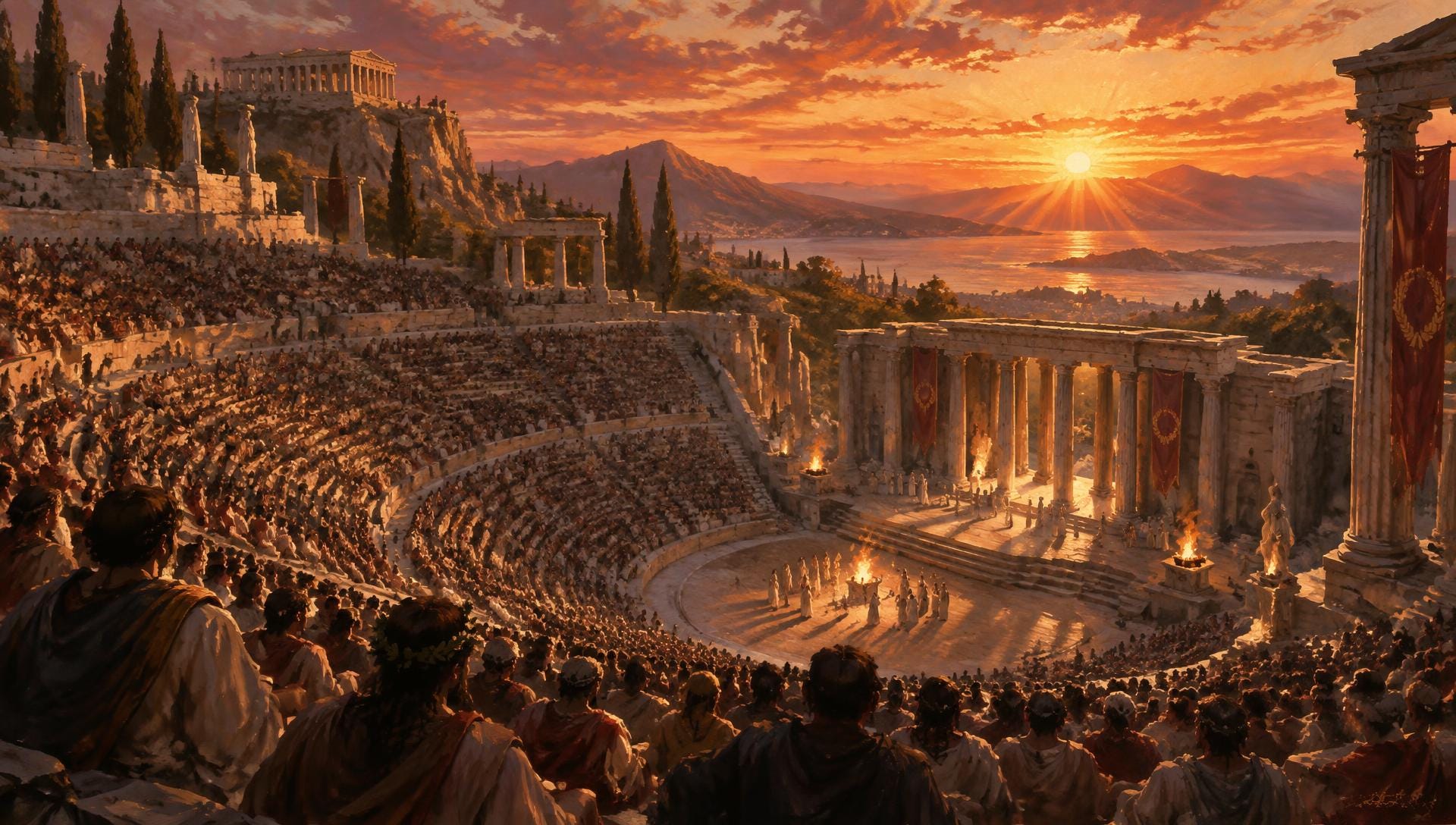
Imagine dawn is breaking in ancient Athens. As the first red rays break through the columns of the theatre, 15,000 people are assembled to partake in an unusual religio-theatrical rite dedicated to the god Dionysus. Over the course of a day they will watch plays, tragedy after tragedy, meant to push the emotions of the audience to ever deeper and more intense levels. Their stated goal? Catharsis — a profound purging and cleansing of the heart and soul. This was a deliberate, collective, high-investment, high-impact process aimed at renewal.
The Jewish People have a day like this too: a 25-hour block of time dedicated to prayer, singing, repentance, and fasting. But there is one crucial difference. In the Greek theatre, the drama unfolds in front of you; you watch someone else suffer and are purified by the spectacle. On Yom Kippur, we are the drama — audience, actor, chorus, and subject all at once.
Despite its challenges and deprivations, the Talmud calls Yom Kippur the happiest day of the year — and with a slight shift in mindset, it is. It’s a different kind of happiness than Passover or Chanukah, when we revel in freedom, deliverance, and victory. Yom Kippur’s joy is more subtle, and harder won. Like two estranged friends making up after years apart, it’s a day of reconciliation that is guaranteed to work if a modest price is paid: effort and sincerity.
When done right, Yom Kippur is epic. It’s like a massive, multi-part symphony or play. There are returning leitmotifs, moving historical accounts, poetry, legal sections, and the opportunity for deep emotional and spiritual cleansing. It’s an entire people coming together on one day to declare their intentions to be better — to grow and change, and to celebrate doing it. What could be more beautiful?
There are those who are — reasonably — daunted by the prospect of a big fast and at least 12 hours in the synagogue. “Why should I make myself light-headed with aching feet for so long? Better to pop in here and there and wait for the break-fast bagels at home, where I can rest.” But here is the amazing thing: those very challenges — pushing against exhaustion, dizzy from low blood sugar, body tensed and straining — are, in and of themselves, the engine of catharsis. Not because suffering is holy, and not because the point is to push the body toward some physical extreme. It’s the same reason the athlete’s exertion deepens the reward: the effort is not the obstacle to the experience — it becomes part of the experience itself.
The hunger and the fatigue wear down the body’s ordinary dominance, quieting the appetites and distractions that keep us at the surface on every other day of the year. And in that emptying, something is allowed to come forward. On Yom Kippur we are enjoined to set the body’s demands aside — to become, in the words of the sages, like the angels, who need neither food nor rest. We are not abstaining as punishment. We are stilling the body so that the soul can finally emerge.
I’ve never experienced the thrill of completing a triathlon, and I’ve never scaled a snow-capped mountain, but I imagine the sheer exertion deepens the final reward immeasurably. I do know that the long haul of Yom Kippur feels that way. In the last few minutes everything comes together — all the searching, the reflecting, the pouring out of the heart — and the fatigue and dizziness somehow catalyze it into something far more powerful.
Those final moments, with the congregation literally screaming to break through to the Infinite, are rapturous. They don’t erase what came before; they crown it, turning the entire day’s effort into the necessary climb that makes the summit blaze.
ALSO FROM THE LOOKING GLASS
The Well
Weekly chaburot in Kabbalah, Jewish philosophy, Mussar and Parsha. Five to ten people, one hour.
Apply for a seat →
I love this reflection. Thank you.