

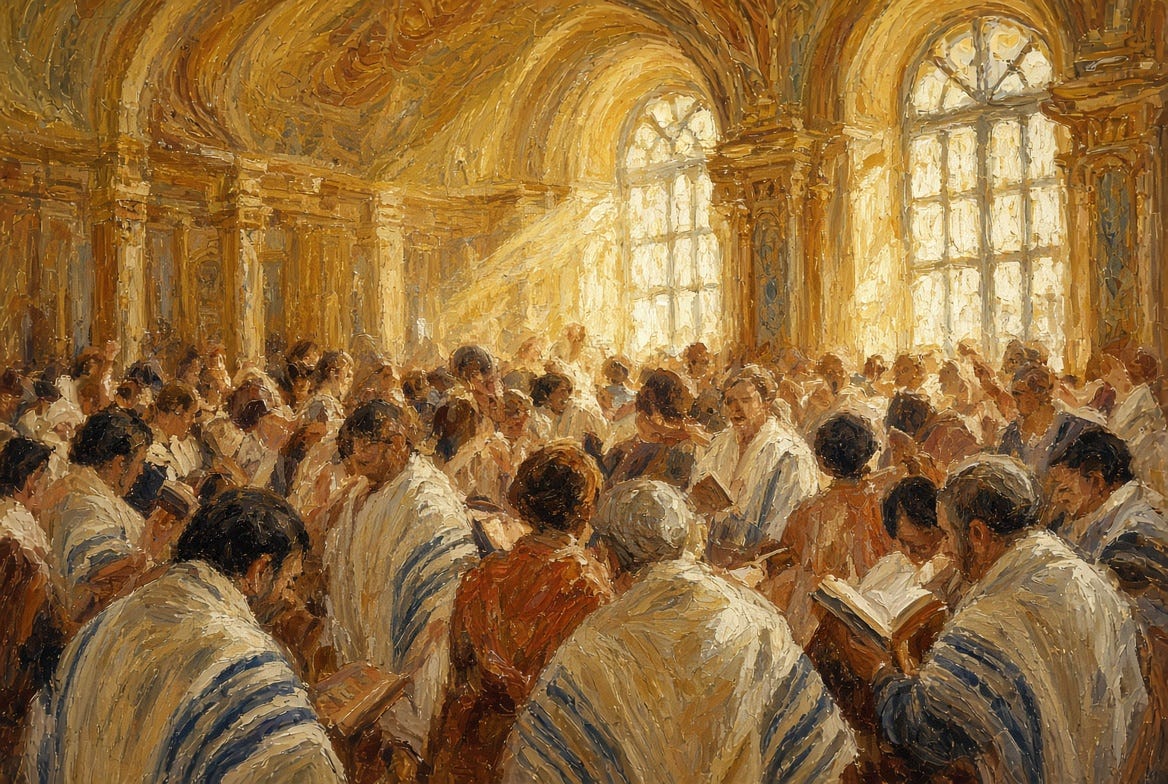
Upon returning from synagogue recently, my fifteen-year-old son — who treats every bodily gurgle as a violation of the social contract — asked me what’s better: praying in a big crowd with everybody sneezing and “horking” every five seconds, or staying home where it’s nice and quiet and you can actually concentrate?
I'd be lying if I said he didn't have a point. I've wondered about this facet of Jewish practice myself. The Eastern contemplative paths hold up calm and stillness as the very goal of practice — the quiet mind, the untroubled breath — and here we are, week after week, trying to reach God in a hall that sounds like a waiting room during flu season. Why does my tradition seem to treat the tumult not as an obstacle to the spiritual life but as a critical part of it?
Jewish prayer has one central section — the Amidah — meant to be said in silence. But the rest of it sounds like a dinner party where everyone is talking at once. It has neither the reverent elegance of a Cathedral Mass nor the disciplined silence of a Zen meditation hall. When it’s done well, though, it feels something like a rock concert where everyone is doing their own thing, together — energy, improvisation, the pulse of life in motion. And kavvanah — intention, the inner focus that is the whole point — is somehow meant to be reached not despite the organized chaos but through it.
If prayer were only about reaching God in whatever way suits you best as an individual — and the loud way doesn’t suit you — then yes, the crowd is a problem, and you’d be right to go home. But that “as an individual” is the whole hidden assumption. My son was measuring prayer by a private yardstick: does it help me concentrate? Judaism hands him a different one: are we doing this together?
Ours is a stubbornly collective spirituality. We do almost everything as a group — Passover seders, bar mitzvahs, brises, and above all, prayer. Even Jewish learning, unlike the Western ideal of the hushed library, is a gloriously noisy affair: hundreds of people standing, sitting, arguing, yelling, flailing their arms. It is intense and unruly and somehow beautiful. It is a lot like life.
So the wisdom traditions that have chosen to block out or sidestep the din of daily life do have a real advantage, and there is an important place for that method. Judaism chose the other road — to barrel headlong into the melee and wrestle it heavenward. It is the deeply embodied expression of a people who love life in all its crazy swirl of emotion and experience. Silence is part of it — the Amidah, after all — but only one of the ways Godliness shows up. Nature has the bubbling brook and the cyclone; both should inspire awe.
Ironically, when I reached for an answer in the moment, what I handed my son was a meditative technique: when your mind wanders or grows agitated, gently bring it back. It’s a simple and valuable tool, and I’d give it to him again. But I’ve come to think it wasn’t the whole answer — because it still treats the noise as interference to be managed, a distraction to return from.
The deeper answer isn’t a better way to tune the crowd out. It’s to understand that the crowd was never the distraction. The coughing and the shuffling and the flailing are not chaos to be seen past; they are the sound of the people he came to stand among. You can reach a purer focus alone. You cannot stand with your people alone. And Judaism, in all its glorious din, has decided which of those it holds more sacred.
The Looking Glass runs programs and events throughout the year. Come see what's on.
So much more to say about all of this related, in particular, to the categorical distinction between fabricated machines and living organisms—such as we are—but also on the ubiquity of phenomenal consciousness and the capacity for ‘trans-action’ and, related to this, ‘free will.’ Both go ‘all the way down ’ to the subatomic level…. I recently presented a paper about these ideas to the 2026 Gathering in Biosemiotics at the University of Sheffield in the UK.
‘Av simchas!’ Is a rallying cry of communal joy and connectivity. The world of living organisms—not only human beings—operates on the basis of relationships and relationality. Relations exceed substance. This is what the refutation of classical Newtonian mechanics through quantum physics is telling us. David Bohm understood this. Basil Hiley understood this. Religio entails the cultivation of relationship and this is especially true for our own species—the human beings is the ‘Semiotic Animal.’ We have gone beyond only using signs and signification to create meaning—we can reflect and examine and understand that this is what we and all of nature does. As CS Peirce recognized—“the entire universe is perfused with signs, if it is not composed exclusively of signs"…. So meaning emerges in the context of community. Ultimately throughout all of nature and beyond.