

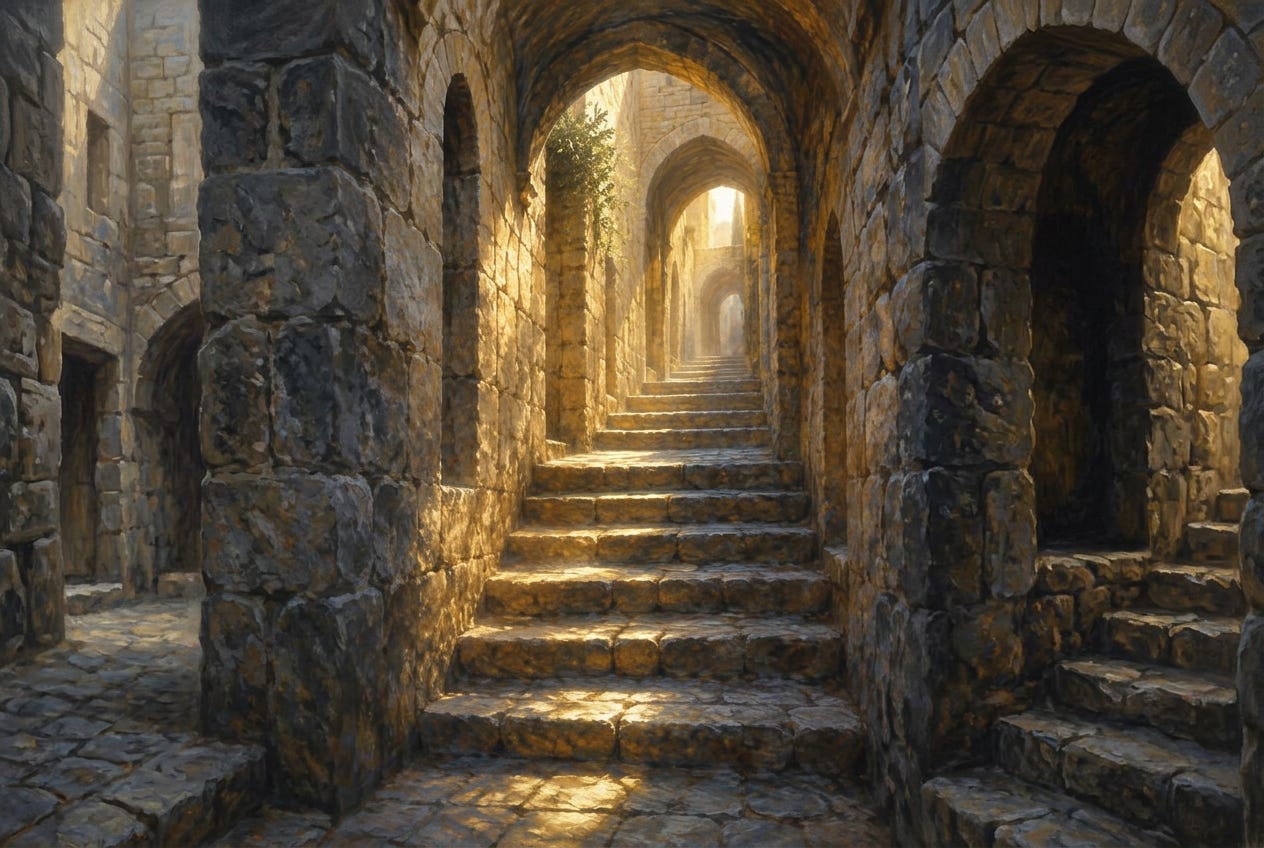
One week ago I found myself ascending through Jerusalem’s Arab shuk from the Western Wall. This covered marketplace has long fascinated me. Shops crowd every few feet along both sides of the narrow staircase, their vendors quietly offering colorful tourist attire, religious articles, pungent spices, and trays of filo-dough sweets. Looking to my left, I peer into a tiny mosque. To my right runs the Christian Quarter Road, which leads to the Church of the Holy Sepulchre. I feel magnetically drawn, like iron filings, in every direction at once. I want to explore all of it. I have an insatiable, inexplicable lust for this city and everything in it.
This feeling, like a long-dormant switch in my soul, activated rather suddenly when I was nineteen, and it has never left me since. Before that, I had almost no interest in the place — or in Judaism, for that matter. When it happened, I figured a stay on a kibbutz was the right first move. In the interview to join the program, the director — managing my expectations, I suppose — asked what I expected to see there. To my surprise, I heard myself say that it didn’t matter: trees, cars, the soil itself would be enough.
In the neighborhood where we were recently staying, I felt it all anew. The olive and cypress trees, the pale Jerusalem stone that’s everywhere, the very air — it’s hard to explain, but the place simply speaks to me.
Then there are the people. The dizzying array of backgrounds and outlooks, the pulse and energy, the odd happiness in the face of endless risk — all of it mashed up and swirled together — grips me. Sitting in a Katzefet downtown (an ice cream shop), I watch. Chassidim of all stripes, soldiers, secular Israelis, tourists, Religious Zionists, Sephardim, yeshiva students, and hordes of children. You can see two thousand years of exile written on them — where they scattered, the cultures that shaped them, all of it carried home. They are living miracles, and I don’t tire of watching them either.
Long before I came to experience it, the Zohar had already named it: Yisrael, Oraita, v’Kudsha Brich Hu chad hu — Israel, the Torah, and the Holy One, Blessed be He, are one. Even though Israel here means the people, I don’t think it’s an accident that the land carries the same name; it feels like an intrinsic part of the same puzzle. The endless mystery many of us feel when we learn Torah — the sense that there is simply no bottom to the layers waiting to be uncovered — bleeds into the people and the land as well, the ground where they live those teachings out. Why this tangible sense of endless possibility? Because, as the Zohar teaches, it is all rooted in Kudsha Brich Hu — the Infinite itself.
As I exit the shuk and make my way toward Jaffa Gate and the newer part of the city, it dawns on me that my endless fascinations are not three separate things but one love wearing three faces. Perhaps it even helps explain the world’s strange, disproportionate fascination with this tiny place and its numerically insignificant people — some dim recognition, from far off, of the same depth. Even that, it seems to me, points toward what I know in my gut. As Jacob declared, waking from his dream at the place our tradition identifies as Jerusalem: “How awesome is this place! This is none other than the abode of God, and that is the gateway to heaven.”