Jutting provocatively from the flying buttresses and roof edges of St. Vitus Cathedral in Prague is an array of rather unattractive gargoyles — animals, fantastical beasts, and human figures, no two alike. The oldest and finest were carved in the 14th century under Peter Parler, the German-Bohemian master mason who shaped the cathedral's Gothic core. Their design was cleverly twofold: functional, draining rainwater clear of the walls, and symbolic — warding off evil and reminding the faithful of sin and judgment.
But the most remarkable thing about Parler's carvings is a detail you cannot even see. Their craftsmanship includes bulging veins and fully modeled mouth interiors — a tongue, a palate — worked with precision, on figures set more than a hundred feet above anyone who might look up.
Now — what is a Catholic cathedral doing at the start of a Jewish essay? Everything, as it turns out.
Because that anonymous carver, chiseling a tongue into a mouth no one would ever peer into, understood something our tradition places near its very center: that the truest measure of a thing is the part no one sees. He worked as carefully on the hidden as on the visible — perhaps more so — as though the worth of the carving had nothing to do with whether a human eye would ever find it. Judaism did not merely admire that instinct. It built a way of living on it.
Judaism places an enormous premium on a way of being that modern life both misunderstands and undervalues: modesty. Through the prophet Micah, we are told what God most wants of us — “to act justly, to love mercy, and to walk humbly with your God.” That famous last phrase, hatzne’a lechet, is usually rendered “walk humbly.” But the Hebrew carries something more specific. Its root, צ-נ-ע, means hidden, concealed, out of sight. To walk with God, the prophet says, is to walk discreetly — to do your deepest living where no one is watching.
The tradition builds on exactly this. The true test of modesty, it teaches, comes when we are completely alone, with no audience nudging us into a performance. In an unglamorous but very real example, the Talmud measures a person’s modesty by their conduct in the beit hakisei, the bathroom — the one place we are truly unseen. The Semak, the halachic work of Rabbi Isaac of Corbeil, codifies it plainly: ein tzanua ela hamitztania b’veit hakisei — none is truly modest but the one who is modest in the most private place.
The tradition calls this quality tzniut — not the narrow modern sense of dress codes, but the older, deeper one: dignity in concealment, the inward self. Ikkar tzniut b’tzina — the essence of modesty is in the hidden.
And there is something profound in the fact that this same hiddenness is ascribed to God Himself. “Wherever you find the greatness of the Holy One, blessed be He,” taught Rabbi Yochanan, “there you find His humility” (Megillah 31a). The greatest Being conceals rather than displays — cares, unwatched, for the orphan and the widow, the ones no one else notices. Greatness and hiddenness turn out to be the same gesture: the refusal to perform. Perhaps it runs in the other direction, too. Wherever you find that quiet, unwitnessed goodness in a person, you have found something very close to God.
The Gothic carver and the Talmudic sage, from opposite ends of the earth, reached the same truth — that the essence of a thing lives in its unwitnessed part. A cathedral is held up by the stones no one inspects; a person is held together by what they do b’tzina — the honesty no one would know of, the restraint no one ever sees.
This is not about being seen to be good. It is about being good whether or not you are seen. The word for it is integrity — from the Latin for whole, undivided. The truly integrated person is not a polished public self laid over a truer private one. There are not two of them. There is a genuine goodness felt within, and the quiet allowing of it to show — indifferent to whether anyone ever knows.
If this way of thinking speaks to you, there’s more where it came from.
The Looking Glass runs a monthly “Ask Anything” session on Zoom — an open hour to bring your questions about Judaism, meaning, doubt, God, or anything else on your mind. No question is off the table. Register / details → here
Join the Ohr Chozer Whatsapp discussion group here.
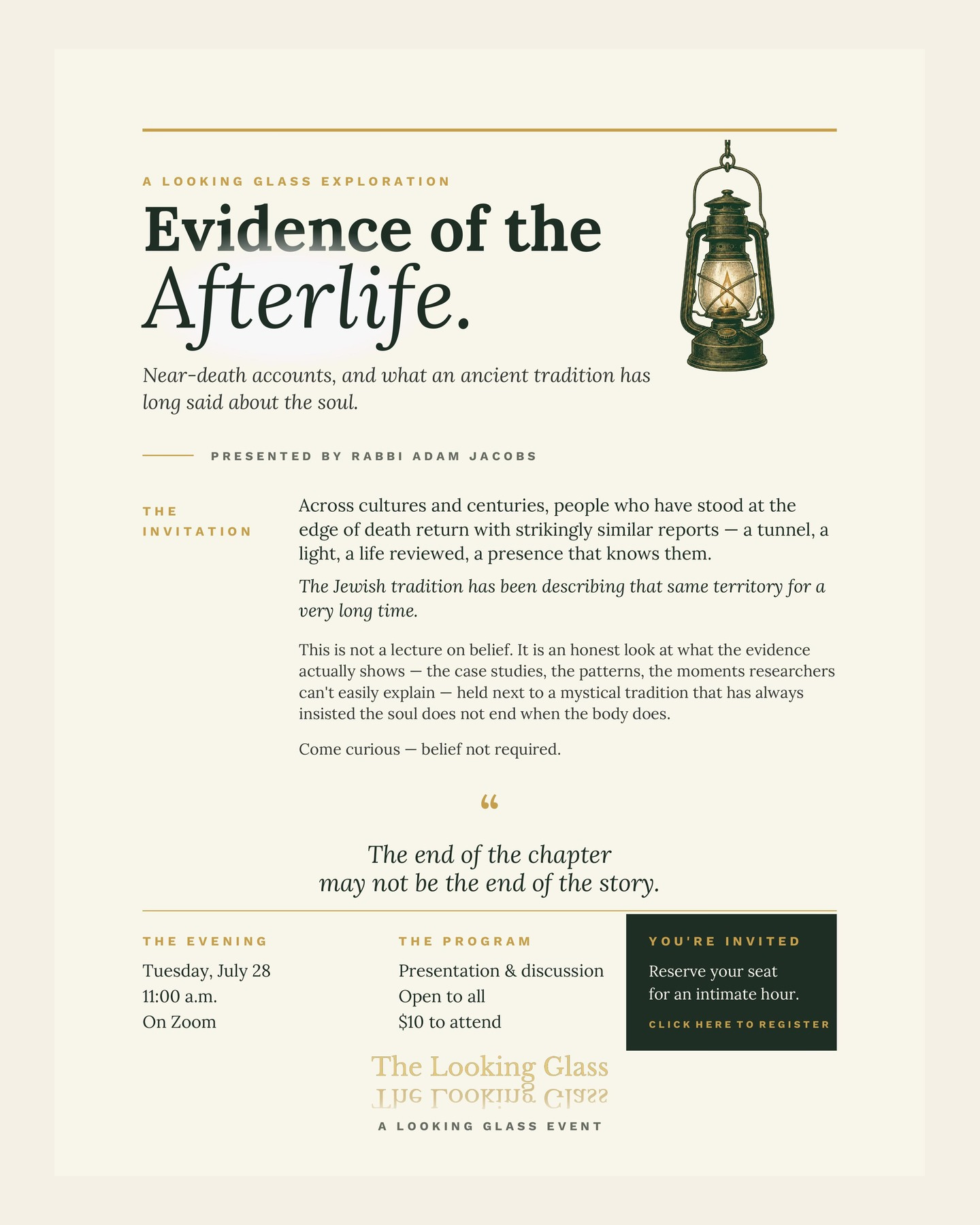
Coming up: On July 28th, I’ll be giving a talk — “Evidence of the Afterlife: Near-Death Experiences and Jewish Mysticism” Register → here