

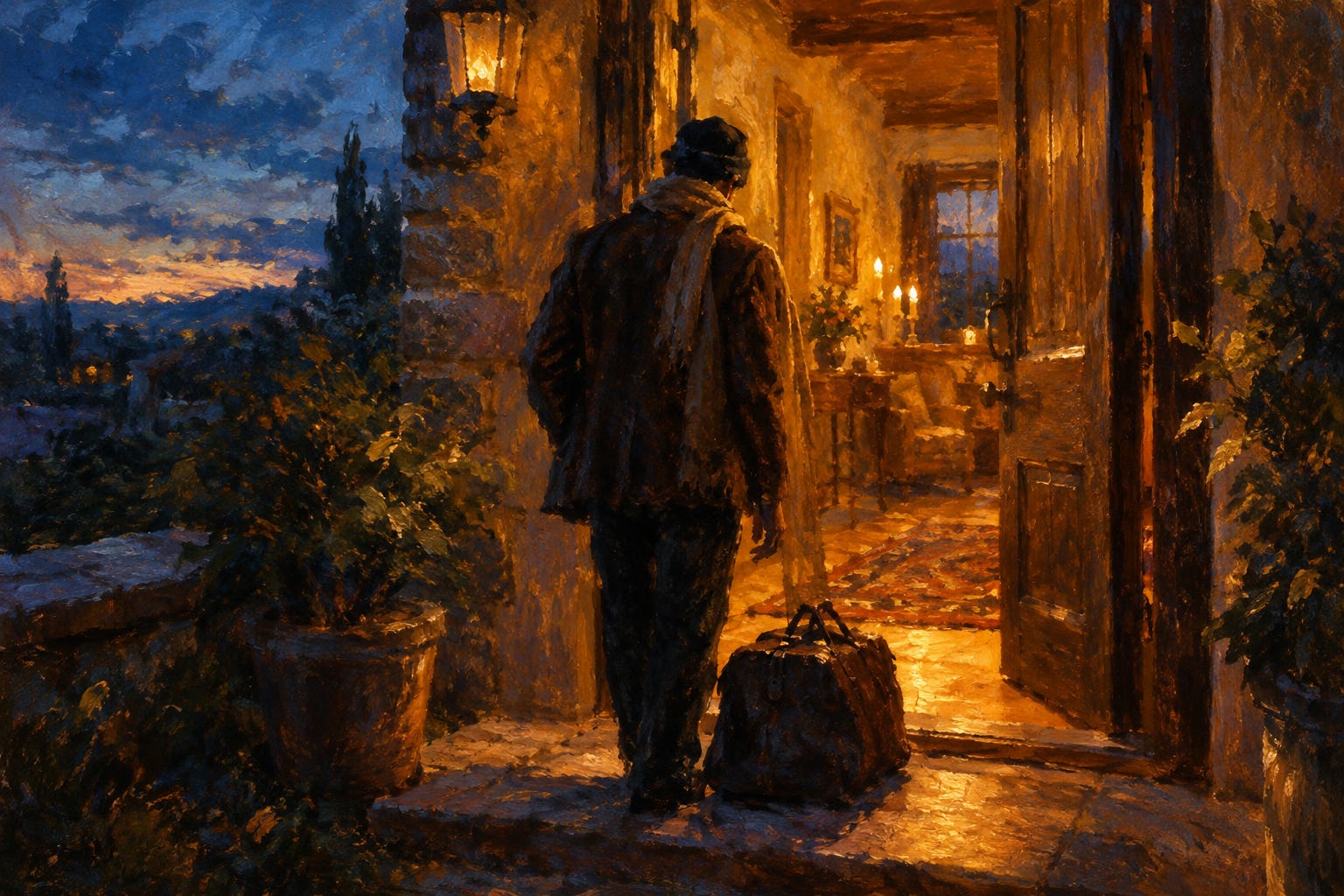
There’s a moment each Friday evening when I transition from the weekday mode to the Sabbath one. Though it’s not always at the exact same point, it’s a definitive awareness that one vibe has ended and another begun. It’s often accompanied by a deep inhalation and a sense of relief that everything I was striving to do, create, or accomplish is now, blessedly, on hold. It’s not that I don’t love my weekdays — I do. It’s just that the momentum can’t be maintained, and those important days of becoming have to give way to one day that’s just for being.
The Talmud has an interesting list of ratios — 1:60, to be exact. It tells us that sleep is 1/60th of death, that dreaming is 1/60th of prophecy, and that the Sabbath is 1/60th of the next world. Why this ratio? It’s considered the threshold of perception. In the laws of kashrut, if a drop of milk falls into meat, the mixture remains permitted as long as the milk is no more than one part in sixty — because at that dilution its taste can no longer be detected. Any more concentrated than that, and the flavor comes through; the mixture is forbidden. Sixty is the vanishing point: the threshold at which a trace becomes imperceptible. All this suggests that, somehow, Shabbat affords us a “taste of the world to come.”
So if the next world, a world of pure being, is so good, then why do we only get the cheese sampler version? Why can’t we have a heartier helping that would leave us with a spiritual bliss that would spill out into the next week and beyond? The surprising answer is that, in our present state, there can be too much of a good thing. Undiluted spiritual presence would be unbearable for us. Recall that at the moment of their greatest transcendent encounter at Mt. Sinai, the people could not handle it and begged Moses, “You speak to us and we will obey; but let not God speak to us, lest we die.” There’s only so much eternity a regular mortal can handle, and anything more concentrated than one part in sixty would, in our present form, be too intense to bear.
Think of it as a kind of training for the real thing. In addition to the physical rest that’s available on the day, we get to practice a different state of being. The rest, defined as a cessation of creative activity, is designed to let us practice simply being. The word Shabbat itself comes from a root meaning to stop. Its first two letters, shin and bet, also begin the word shuv — to return. This makes sense. It’s extremely difficult (though not impossible) to connect with transcendent things when we’re getting our teeth cleaned, doing carpool, or running for a bus with an umbrella. The volume of activity — the deadlines, the challenges — is so distracting that to do it 24/7 would make it unlikely that we’d ever learn simple being-ness and the sense of peace that comes along with it.
The six days of the work week are a fantastic thing and play an equally critical role in this system; one can’t exist without the other, and those days of becoming shouldn’t be thought of as merely a springboard to the Garden. Judaism is intensely focused on this world, on the here and now. For six days we are meant to strive — to push and change and grow. When Shabbat arrives, it comes as a crown for the days that preceded it, sanctifying and elevating what came before. It also helps us realize that the world continues to function without our intervention. Sometimes we feel like Atlas, the weight of the world on our shoulders, afraid that if we set it down the whole thing will come to a screeching halt. Shabbat shows that it was never us to begin with, and that if we rest our arms, we’ll all survive.
That’s essentially what happens to me on Friday nights. Like the relief when a car alarm that’s been blaring for an hour suddenly goes quiet, I take my first deep breath of pure being all week, and my arms (and my soul) start to feel much lighter.
On another note, I’m hosting a live Feed Your Head session you’re warmly invited to.
