

There have been some astounding screams in the annals of rock and roll, but a few are truly elite. Three minutes and forty-nine seconds into Joe Cocker’s album rendition of “With a Little Help from My Friends,” you hit something like pure primal catharsis. Roger Daltrey’s banshee cry in “Won’t Get Fooled Again” may be the gold standard. There are moments in a song where the words sputter and fail, and the only way to push it as far as it can go is to abandon language for pure, raw sound — straight from the soul.
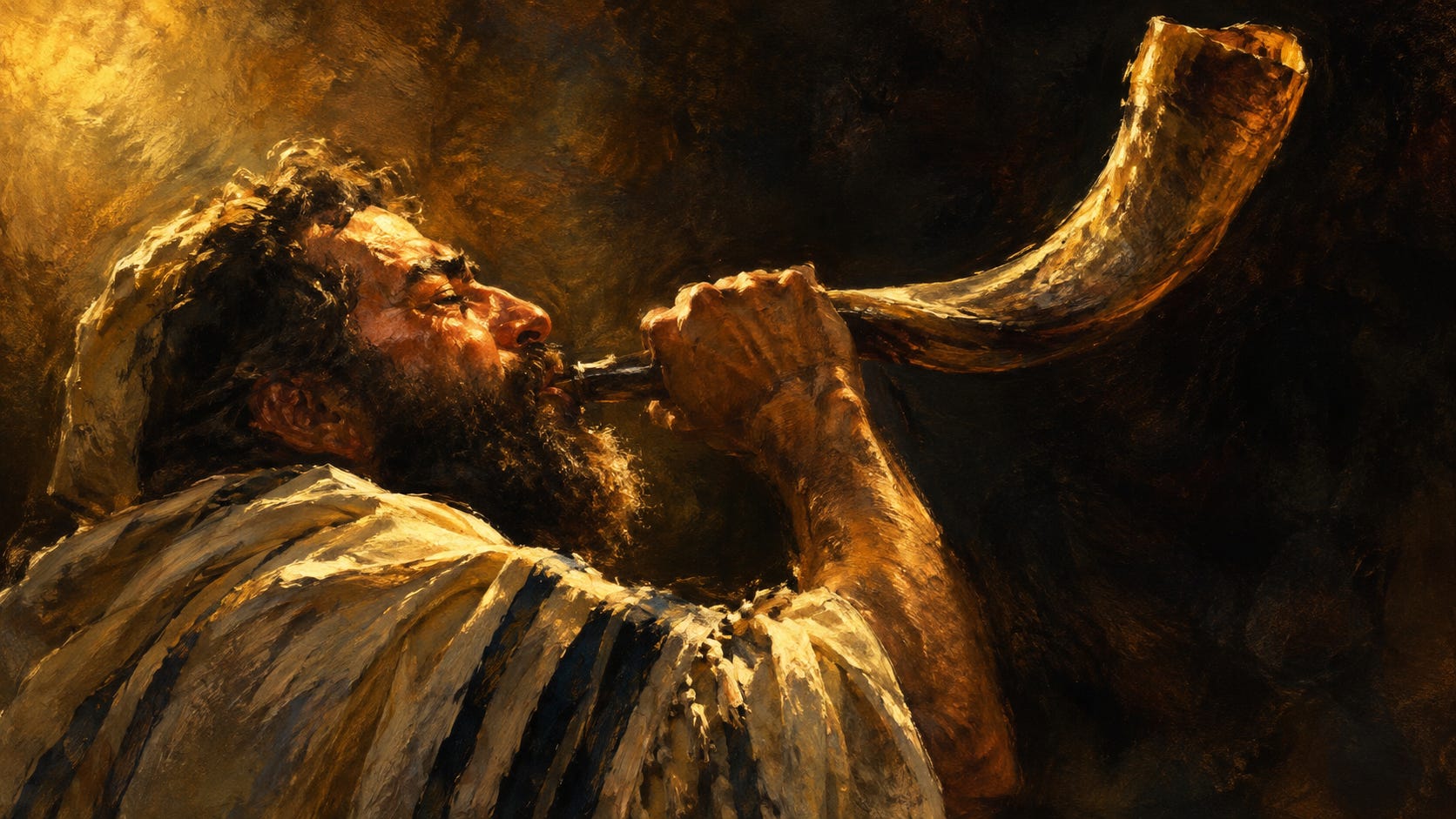
That same move — words giving way to raw sound — is, I think, the secret of what may be the highlight of Rosh Hashana: the shofar service. Roughly halfway through, the congregation solemnly turns toward the baal tokea (literally, the “blast master”) and listens to a sequence of tones sounded on a ram’s horn. But why? What does this sound have to do with the new year? Many reasons have been offered: that it ushers in the year, that it confounds the accuser, that it recalls the ram Abraham offered in place of his son Isaac. But these only scratch the surface. The core reason, I think, is deeper.
The shofar is our primal cry to God — the raw sound of the soul when words fall short. Judaism insists that an intimate, powerful relationship with the Creator is possible, even though we cannot see Him or hear His voice directly. Known to us or not, the soul aches to return to its source, to be in contact with its home. The same longing we feel for the place we were born, the house we grew up in, runs in our inner selves too: a homesickness for the source it came from, a yearning to close the distance. The wail of the shofar is that longing in sonic form, powerful enough to smash through the boundaries of Heaven and Earth.
If you listen carefully, the sequence of the blasts teaches something further. The series always begins with a tekiah, a single long sound, followed by either shevarim (three broken sounds) or teruah (many short, staccato ones), and then tekiah again. The pattern is whole, broken, whole. In fact, the word shevarim means “broken.” This is the human experience rendered in sound, as individuals and as a people. We all start off whole. In time, life’s challenges reach every one of us; some experiences smear us, some crack us, some shatter us. And the Jewish belief is that within that very brokenness lie the seeds of repair — a return to wholeness, but at a higher level than where we began.
The soul’s journey through this world is a deep and difficult thing, and there is no one on the path who will not, sooner or later, meet a shattering force. This is as it should be. The work is to keep moving, not to get stuck in the brokenness. And in those moments when you can’t see the way out, crying out is not merely permitted — the cry itself is a hammer that can batter a new opening in the wall of impossibility. This is the shofar service: the acknowledgment that our lives are not yet what we need them to be, and the fervent yearning to blow away our boundaries.
The service’s final sounding is called the tekiah gedolah — the great blast, held as long as there is breath to sustain it. It is the sound of the wholeness we are reaching for: not the untested wholeness we began with, but the fuller one waiting on the far side of everything that broke us. We are not there yet. But once a year, we get to hear it — held, unbroken, as long as the breath will last.
ALSO FROM THE LOOKING GLASS
The Well
Weekly chaburot in Kabbalah, Jewish philosophy, Mussar and Parsha. Five to ten people, one hour.
Apply for a seat →
Ohr Chozer
A private, judgment-free space for people working through doubt, or just beginning to ask.
Ask to join →